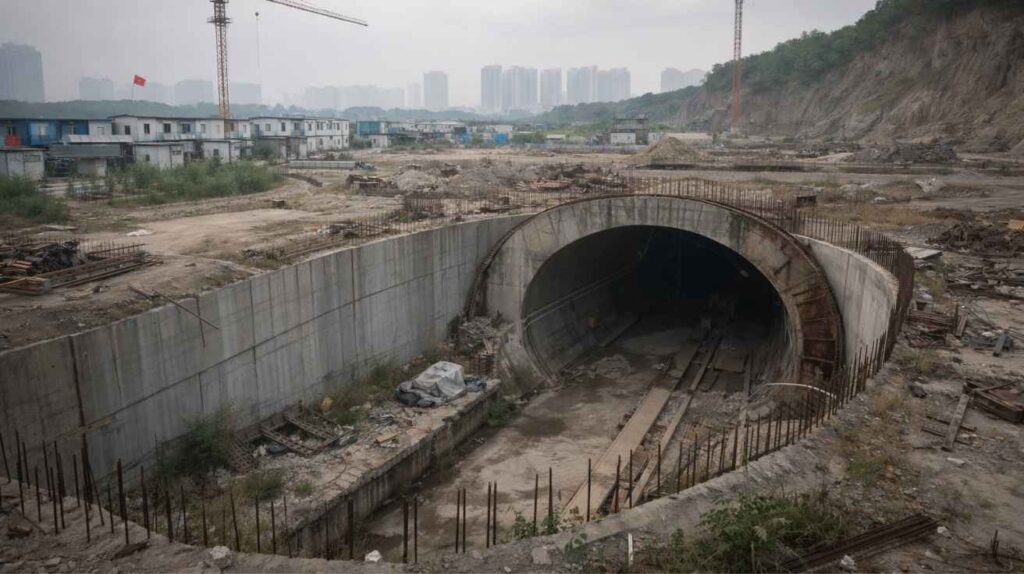
China once aimed to challenge Europe by building what could have become the world’s most powerful particle accelerator, a massive scientific machine designed to explore the deepest secrets of the universe. However, the enormous cost and economic pressures have forced the country to slow down and reconsider its plans. The ambitious idea promised breakthroughs in advanced physics research, global scientific leadership, high energy experiments, and future technology development. Yet for China, even with its strong investment in science, the financial scale required for such a project has become difficult to justify.
China’s Particle Accelerator Project Faces Financial Reality
China’s proposal to construct a massive particle accelerator was designed to rival Europe’s famous Large Hadron Collider. The project aimed to establish a new era of next generation collider capabilities while strengthening China’s position in global research competition. Scientists believed the machine could unlock mysteries of fundamental particle physics and help researchers study dark matter clues more deeply. However, building and maintaining such a facility requires decades of funding, complex engineering, and international collaboration. As economic priorities shift, policymakers have begun questioning whether the investment aligns with the country’s broader scientific and financial goals.
Europe’s Existing Accelerator Sets the Benchmark
Europe’s Large Hadron Collider has long been the gold standard in particle physics experiments, offering groundbreaking discoveries and global cooperation. The facility, operated by CERN, represents an enormous achievement in international science collaboration and continues to drive cutting edge discoveries. China’s planned accelerator was expected to surpass the collider’s capabilities through higher collision energy and improved precision measurement systems. However, matching Europe’s decades of infrastructure, research networks, and expertise is no small task. Experts argue that building a rival facility would demand enormous investment while still facing strong competition from established international laboratories.

Economic Pressures Force China to Reconsider
Although China has invested heavily in scientific infrastructure, the proposed accelerator comes with a staggering price tag that could reach tens of billions of dollars. In a period of shifting economic priorities, government planners are carefully evaluating projects that require long-term spending. Concerns about massive construction expenses, long term maintenance, and budget allocation challenges have sparked debate among policymakers and scientists alike. Some researchers support redirecting funds toward more immediate scientific programs that promise faster results. As a result, the ambitious accelerator race with Europe has slowed, reflecting a broader reassessment of national research priorities.
Scientific Community Reacts to China’s Decision
The global physics community has reacted with mixed emotions to China’s decision to pause its accelerator ambitions. Many researchers had hoped the project would open new opportunities for large scale experiments and expand international research networks. Others believe that resources might be better used to strengthen existing laboratory programs or invest in emerging technologies. While disappointment exists among some scientists, others see the move as a realistic response to financial constraints. The debate highlights how complex scientific mega-projects must balance discovery, collaboration, and economic sustainability.
Future of Particle Physics Beyond Mega Colliders
Even though China has slowed its accelerator plans, the global quest to understand the universe continues. Researchers are increasingly exploring alternative paths such as advanced detector technology, smaller precision experiments, space based observatories, and quantum research platforms. These approaches may complement traditional colliders while delivering new insights into cosmic mysteries. Scientists believe future breakthroughs may come from combining multiple research strategies rather than relying solely on giant machines. China remains an important contributor to global science, and its future projects may focus on innovative methods that require less financial risk but still deliver meaningful discoveries.
Scientific and Economic Implications
The pause in China’s accelerator project highlights the complex balance between scientific ambition and economic practicality. Mega-projects can drive extraordinary discoveries, yet they also demand sustained political commitment and financial stability. The situation emphasizes the importance of strategic research planning, long term funding, international collaboration models, and balanced innovation investment. While Europe currently maintains leadership in large collider experiments, global physics research continues evolving through partnerships and technological progress. China’s decision may reshape how countries approach major scientific infrastructure in the coming decades.
| Project | Location | Estimated Cost | Main Purpose |
|---|---|---|---|
| Large Hadron Collider | Europe (CERN) | $4–5 Billion | Study fundamental particles |
| Future Circular Collider | Europe (Proposed) | $20+ Billion | Next generation collisions |
| China Circular Electron Positron Collider | China (Planned) | $5–10 Billion | Higgs boson research |
| International Linear Collider | Japan (Proposed) | $7–8 Billion | Precision particle experiments |
| Compact Linear Collider | Europe (Concept) | $6–7 Billion | High energy collisions |
Frequently Asked Questions (FAQs)
1. Why did China halt its particle accelerator plan?
China slowed the project mainly due to extremely high construction and long-term operational costs.

2. What was the goal of the proposed accelerator?
The goal was to study fundamental particles and expand knowledge about the universe.
3. Which accelerator currently leads global research?
The Large Hadron Collider in Europe remains the most powerful operating particle accelerator.
4. Could China revive the project in the future?
Yes, experts believe the project could return if financial and research priorities change.