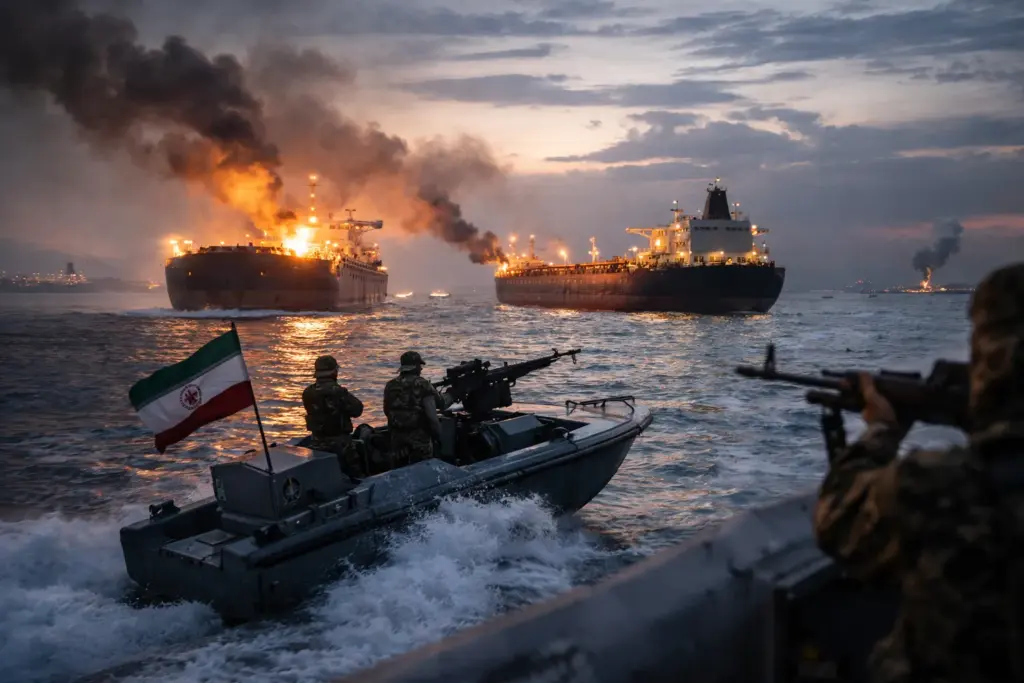
As tensions between the United States and Iran continue to escalate, Iran’s Islamic Revolutionary Guard Corps (IRGC) has issued a strong warning regarding the strategic Strait of Hormuz, one of the world’s most important oil transit routes. The military force signaled that it could prevent oil shipments from passing through the narrow waterway, raising serious concerns across global energy markets.
With the possibility of disruption in one of the busiest maritime oil routes, governments, shipping companies, and energy traders are closely watching developments in the region. Any interruption in the flow of oil through the strait could immediately affect global fuel prices and international trade.
Strait of Hormuz and Its Role in Global Oil Supply
The Strait of Hormuz is widely considered the most important oil chokepoint in the world. Roughly one-fifth of the global oil supply moves through this narrow channel each day, connecting the Persian Gulf with international markets.
If shipping through the strait were halted, the consequences could be severe for global energy markets. Oil supplies from major producers in the Middle East could be delayed or blocked entirely, causing sharp price increases and supply shortages in multiple regions.
Energy analysts warn that if the crisis continues, oil prices could potentially surge to levels close to $200 per barrel, creating ripple effects across transportation, manufacturing, and household energy costs.
IRGC Issues Strong Warning to Western-Linked Vessels
Officials from the IRGC’s Khatam al-Anbiya command center have taken a firm stance during the growing confrontation. According to statements released this week, vessels associated with the United States, Israel, or their strategic partners could be considered potential targets if the conflict expands.
This rhetoric has significantly increased tensions in the region and raised concerns among international shipping companies that rely on the safe passage of commercial cargo through the Strait of Hormuz.
Energy markets and shipping insurers are already factoring in the increased geopolitical risk as uncertainty spreads throughout the maritime sector.
Military Escalation Drives Oil Market Volatility
Recent military developments have intensified fears of disruption in the Persian Gulf. Reports indicate that several commercial ships near the Strait of Hormuz were struck by projectiles, including a cargo vessel flying the Thai flag.
These incidents highlight the growing risks faced by shipping traffic moving through the region.
Despite the dangers, US President Donald Trump has encouraged maritime traffic to continue operating through the strait, expressing confidence that security measures will allow vessels to move safely.
However, maritime experts remain cautious, warning that the situation could deteriorate quickly if further attacks occur.
Humanitarian Groups Call for Protected Shipping Routes
Amid the military tensions, humanitarian organizations are urging all parties involved to ensure that critical aid shipments can move safely through the region.
UN humanitarian chief Tom Fletcher has called for special exemptions for vessels carrying humanitarian assistance, including food and medical supplies destined for vulnerable regions.
According to Fletcher, uninterrupted access to shipping routes is essential for delivering aid to parts of Africa and other regions that depend on maritime supply chains.
Countries Release Emergency Oil Reserves
To reduce the immediate impact of supply disruptions, the International Energy Agency (IEA) has announced plans to release 400 million barrels of oil from emergency reserves held by member countries.
The move is designed to stabilize global energy markets while diplomatic efforts attempt to resolve the crisis.
Several countries have also pledged additional releases from their strategic reserves.
| Country | Emergency Oil Release Plan |
|---|---|
| Japan | Approximately 80 million barrels from national and private reserves |
| Germany | Portion of strategic petroleum reserves to stabilize supply |
| Austria | Coordinated release through international reserve programs |
IEA Executive Director Fatih Birol emphasized that reopening the Strait of Hormuz remains the most important step toward restoring stability in global oil and gas flows.
Experts Warn of Extended Energy and Shipping Crisis
Maritime security experts are warning that prolonged closure of the Strait of Hormuz could trigger a major disruption in global shipping.
Christian Bueger from the University of Copenhagen noted that current security conditions make it extremely difficult for commercial ships to safely pass through the waterway.
According to analysts, if safe transit is not restored soon, the global shipping industry could face delays lasting weeks or even months.
Such disruptions could lead to rising energy costs, higher transportation expenses, and broader economic consequences across international markets.
Uncertain Outlook for Global Energy Markets
As the geopolitical confrontation between Iran and the United States continues, global energy markets remain highly sensitive to developments in the region.
While the temporary release of emergency oil reserves may provide short-term relief, long-term stability will depend on diplomatic efforts and the reopening of critical maritime routes.
World leaders and energy experts are closely monitoring the situation, hoping that negotiations can reduce tensions and restore safe passage through the Strait of Hormuz before the crisis deepens further.