On a Tuesday, the first silver strand appeared. It sparkled in the bathroom light as if it had something to say. For a moment, you leaned in closer to the mirror, your fingertips brushing against the stray hair. It was a small, bright line of truth cutting through the brown, blonde, and carefully chosen colour of the last ten years. You might have freaked out, grabbed some tweezers, and made an appointment for a last-minute balayage touch-up. Now you just watch it, curious and a little scared, quietly wondering if there is a way to make peace with it instead of fighting it. And maybe, just maybe, make it pretty.
When Balayage Wasn’t Enough Anymore For a long time, balayage was the unsung hero of modern hair colour. It was sunny, easy to care for, and lived in. It gave us that vacation glow without the cost of the flight. The illusion that “it just happens naturally.” It was perfect until the greys started coming in with more confidence and less subtlety.
You might remember the change. At first, there were a few sparkles here and there near the temples. Then a stubborn wave at the parting wouldn’t lie down under a smear of toner. All of a sudden, balayage felt like a compromise. The ends were too light, the roots were too harsh, and the coverage was too thin where you needed it most. The soft, hand-painted ribbons of colour that used to say “easy” now scream “I’m trying to hide something.”

Salons were the first to hear it. People in their thirties, forties, and fifties who liked the look of balayage but wanted something gentler on grey hair. They didn’t want to get rid of time; they just wanted to make it a little less clear. To look less like “high-contrast roots and stripes” and more like “softly lit by candlelight.”
“Have you heard of melting?” started to quietly pass from stylist to client, from mirror to chair.
What “melting” really means: Colour that moves like light “Melting” sounds dreamy and vague, like chocolate, sunsets, or snow. But in a salon, it is very exact. With colour melting, you mix different shades so well that you can’t tell where one ends and another starts. There are no lines or clear starting points; the tone slowly changes from root to mid-length to ends.
Think of three colours: one that is close to your natural colour, one that is a little lighter, and one that catches the light a little more. Instead of painting them in blocks or streaks, your stylist overlaps and blurs them with brushes, gloved fingers, and sometimes even the heat of their own hands. The line between colours doesn’t just get softer; it disappears. The end result looks less like “hair dye” and more like “this is how the sun has always treated my hair.”
And here’s the quiet magic: when grey hair is in the picture, all that softness and gradation turns those wiry white strands from “intruders” into “accents.” Greys aren’t being fought in a harsh battle of coverage vs. regrowth; instead, they’re being wrapped in tone and gently hidden in a landscape of similar colours.
How Grey Hair Fits In Grey hair isn’t just about the colour; it’s also about how it feels and how it reflects light. It usually feels rougher, drier, and more light-catching than pigmented hair. Grey hair tends to stand out as soon as the roots grow a few millimetres with single-process colour or regular highlights. When your stylist melts your hair, they use colours that are similar to the brightness of the greys, like soft ash, muted beige, smoky taupe, creamy champagne, or even pearlised brunettes. The greys start to fit in with the rest of the story instead of being a separate subplot that wants to take over.
When you leave the salon, your hair has movement, both visually and emotionally, instead of just one flat curtain of coverage. Even when it’s perfectly still, it looks like it’s moving.
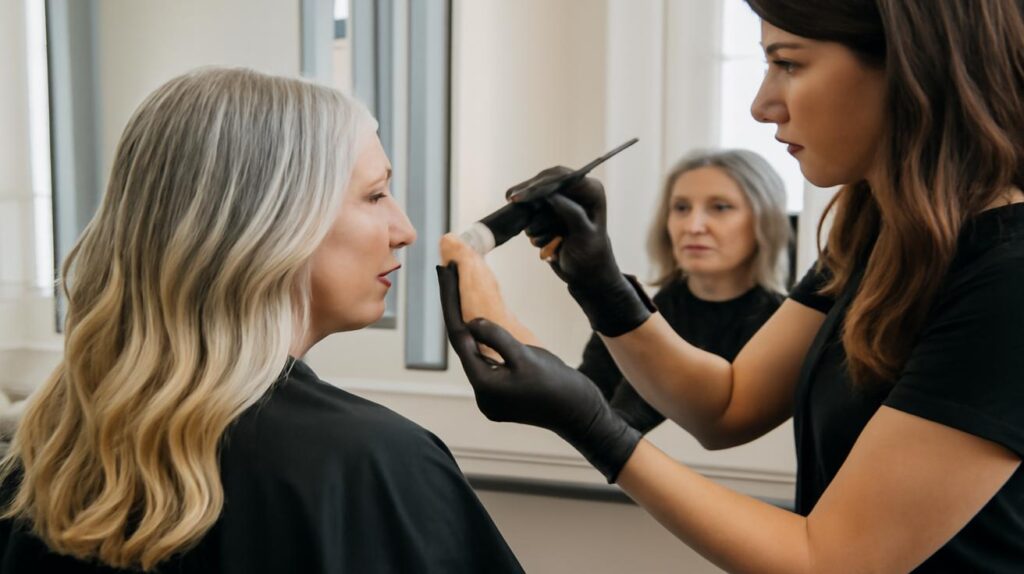
The Moment in the Chair: How Melting Really Happens Imagine yourself sitting in the chair. The cape snaps shut around your shoulders, and the world shrinks to just the mirror, the stylist’s hands, and the soft sound of bowls and brushes hitting each other. This isn’t a quick job; melting is on purpose, and it should take a little longer, like painting a canvas instead of filling in a colouring book.
Your stylist looks at your hair to see where it’s darkest, where it naturally lightens, and where the greys hide in little constellations. Then they mix colours, usually two or three, but sometimes more. The root shade is usually close to your natural colour, but it might be a little softer. The middle is a colour that helps the root and ends blend together. The ends are lighter, but not too much; they have a soft shimmer instead of a bright light.
This is where the art happens. The colour is put close to the roots, then pulled and smudged down to meet the next tone. Fingers make the lines less clear by feathering and pressing, which gives the effect of “no hard lines.” In some cases, foils can be used, but most of the time the colour is open-air, which lets it breathe and move.
At first, the product looks dull and matte under the salon lights. But you can feel the difference before you even see it when you rinse it out and tilt your head back, letting the water rush over your neck and the weight of clean hair against your neck. The strands slide through your fingers like silk. Then the big reveal: head up, hair combed forward, black cape with tiny cut ends glinting in the light, and there it is in the mirror. No clear highlight lines. No band of “root” yelling from your head. It’s just a change, like the sky getting darker at night.
The Secret to Grey Being “Almost Unnoticeable” Melting doesn’t get rid of your grey. It draws the eye away. When the colour changes slowly from dark to light, the little flashes of silver in between look like part of that change. You don’t panic at your roots anymore. Grey is just one player among many, not the whole show.
Balayage often used contrast, like dark roots and light ends. Melting, on the other hand, uses harmony. On hair that looks expensive because it looks like it took time, care, and self-control.
A quick look at melting, balayage, and traditional colour With all the buzzwords about hair colour, it’s easy to get lost. If you have grey hair at your table, here’s how melting fits into the bigger picture.
| How It Looks | Technique | Grey Coverage | Feel | Upkeep |
|---|---|---|---|---|
| Single-Process in the Past | One colour from root to tip | Maximum coverage, but lines of regrowth are clear. | High—roots show up quickly | High—roots show up quickly |
| Balayage | Hand-painted ends that have been kissed by the sun and a darker root | Good for blending, but not as good at heavy grey roots. | Low to medium—grows out gently | Low to medium—grows out gently |
| Colour Melting: A smooth gradient of tones with no harsh lines | Greys were less noticeable and more spread out. | Medium: soft regrowth and fewer emergency appointments. | Medium—roots appear soft | Medium—roots appear soft |
Melting is a good friend for grey hair because it doesn’t pretend that your roots will stop growing. It just makes the colour so that they don’t shout when they do.
Picking Your Own Type of Melt There is no one “grey friendly” formula. There are palettes, moods, and ways of life instead. Depending on who you are and how you style your hair, melting can be warm or cool, subtle or bold, sandy or smoky.
If you have dark hair and are just starting to go grey You might think that every grey is a bright sign on a dark background. When you melt, it usually means keeping the root close to your natural shade, but with a little less depth, not the flatness of boxed dye. The mid-lengths can change to a cooler chocolate or a neutral mocha, and the ends can catch some light in a soft caramel or muted hazelnut.
The greys at your part and temples mix with a root shade that lets in a little light. Your stylist doesn’t try to get perfect coverage; instead, they leave a hint of brightness behind, surrounded by other colours.
If You’re Blonde and Your Greys Look Like Highlights Blondes sometimes have an unfair advantage because their first grey hairs look like they were put there by accident. But as more come, the overall effect can become uneven or dull. When blondes melt, they usually lean into that naturally bright story, but they have more control over it.
Think about it more: buttery or wheat-blonde near the roots, and cool vanilla or champagne through the lengths. A soft, smoky toner can help your greys go from bright white to pearly. This will blend them into the melt instead of letting them flare.
If you’re ready to accept your grey hair but still need help Some people are walking right into their silver age with their heads held high and their hearts open. If that’s you, melting can help you get there. Your stylist can use a translucent, demi-permanent colour at the roots instead of trying to hide your grey. This will soften the contrast without completely hiding it. The middle of your hair might stay close to your natural colour, while the ends might get a silver or slate shine that matches your grey hair.
As you grow more natural silver over time, you won’t need as many melting appointments. The colour changes with you, not against you.
The Luxury of Low Maintenance Living on a four-week root schedule can be very stressful. It’s the counting down the days on the calendar, the rushed meetings, and the quiet fear you feel when you see yourself in a lift mirror under fluorescent lights. Melting slowly loosens that grip.
Your regrowth doesn’t make a hard line because the technique makes the root area softer. Instead, you get a grace period of a few extra weeks during which your hair still looks like it was coloured on purpose, not overdue. The root shading slowly fades into your natural colour, and the lighter spots don’t start out of nowhere; they just show up, like light coming into a room during the day.
You don’t have to go to the salon every month. It is now possible to go from six to ten weeks. For some, it lasts even longer. Your hair still looks good in lifts, car mirrors and café windows between appointments. It looks three-dimensional under warm lamps at dinner, with shadows and light playing on it, not just one flat stroke of colour.
The Ritual, Not the Help Melting may not only change how things look, but also how they feel. Going to the salon stops feeling like an emergency and starts to feel like a ritual. You’re not rushing in to “fix the grey situation” anymore. You’re going in to make small changes to what already works.
That shows a quiet sense of confidence. You don’t want to stay stuck at twenty-nine. You’re creating a colour story that changes with you, letting age show up but not take over the scene.
Taking Care of Melted Colour: Texture and Daily Life Your hair looks healthier when it has different tones instead of just one dense colour. This is true even if it’s just better lit. But how you take care of it is important, especially since it has grey in it.
Hair that is prone to grey often feels drier, and hair that has been coloured needs moisture to keep its soft, shiny surface. A sulfate-free shampoo, a hydrating conditioner, and a mask every now and then become less of a treat and more of a small promise to yourself: “I will keep this softness that I worked so hard to make.”
Tools for heating? Still okay, but with more care. Before using a curling iron or straightener, you must use a heat protectant spray. Not because you’re afraid, but out of respect. These little things, like letting your hair air dry on the weekends, tying it up in loose, silk-friendly styles at night, and sleeping on a smooth pillowcase, help keep each tone in your melt bright instead of brittle.
And then there’s that one random afternoon when you walk past a store window and see it for a split second: hair moving in the light, silver glints not standing out but swimming in a sea of soft colour. You don’t move. You look at yourself in the mirror for a second longer than you used to, and you’re surprised by what you see.
Goodbye, Balayage? Not really, more like “Thank You, Next.” This isn’t a story about ending balayage. It had its time, and for some people, it still works great. But for a lot of people who are starting to get grey hair—partially, slowly, or fully—melting is a more graceful answer.
It doesn’t guarantee that you will never see a grey again. It doesn’t preach that you should stay young forever. Instead, it gives you something more real: the idea that your hair can be a gradient instead of a battlefield. That your colour can be soft and three-dimensional without needing to be fixed or apologised for all the time.
Picture this: you’re in your stylist’s chair, and instead of saying, “Can we just cover all the greys?” you say, “Can we make them part of the picture so they’re not the only thing I see?” That’s what melting sounds like. Not denial, but design.
And the day you realise you’ve gone two or three weeks past your “usual” touch-up time and no one has said anything—not even you or the loud little critic in your head—you might run your fingers through your hair, feel how it moves, and get why people are saying goodbye balayage, it was nice while it lasted. But this? This grey that is soft, blended, and almost invisible? This is how I feel.
Questions and Answers
Does colour melting cover grey hair all the way?
Not always, and that’s on purpose. Melting is more about mixing and spreading grey than getting rid of it. If you want more coverage, your stylist can use a colour that is less see-through at the roots. However, the overall effect is softer and more dimensional than a solid, single-process colour.
How often do I need to fix colour that has melted?
Most people make appointments every 6 to 10 weeks, depending on how fast their hair grows and how grey it is. Because the technique has low contrast at the roots, you usually have more time between visits than with solid colour.
Does melting hurt the hair?
Any chemical colour can be bad for your hair, but melting isn’t any worse than balayage or highlights. A good stylist will change the strength of the developer, the amount of time it takes to process, and the treatments after colouring to keep your hair as healthy and hydrated as possible.
Can melting work on hair that is very dark or very curly?
Yes. When you melt dark hair, the changes are usually small, like going from deep espresso to soft mocha to warm ends. This makes the grey less noticeable. This method can look especially nice on curly hair because curls naturally break up colour, which makes the blend look even more natural.
If I want this look, what should I ask for at the salon?
Say “colour melting” and “soft root blend,” and tell them that you don’t want your grey to go away completely, just less noticeable. Bring pictures of melts that are similar to your hair length and texture, and be honest about how often you are willing to come in for maintenance.